.png)
All BOGUE BANKS is Divided into THREE Parts...Part ONE
- Denis Raczkowski

- Oct 21, 2020
- 3 min read
Updated: Oct 28, 2020
Some of you recognize me as the co-owner of Flip Flops Donuts and some of you know me as your broker of real estate specializing, in waterfront and water view properties along the Crystal Coast, especially in Emerald Isle, NC located on Bogue Banks. The island of Bogue Banks has some of the richest history along the entire NC Crystal Coast and names such as Henry Fort, Alice Hoffman, and Nathaniel Macon add a unique aura to the island. This blog is all about the history of Bogue Banks, and whether you visit here occasionally or live here full time, it is a history that deserves telling.
Part ONE...Fort Macon and Atlantic Beach
Like many of North Carolina's coastal islands, Bogue Banks was first home to Indians; the Algonquin Indian tribe occupied the surrounding countryside from about 500 A.D. to colonial times. Later, the area was settled by whalers and fishermen. Much like Caesar observed that all Gaul can be divided into three parts, the modern history of Bogue Banks can be best appreciated if we divide its development into three phases. The first phase takes place in the 1800’s and focuses on the eastern third of the island. What started as series of small fishing villages with little regard to land ownership and distinct communities changed when a Lieutenant Eliason surveyed the eastern end of Bogue Banks in 1826 for the purpose of constructing a military fort to protect our young nation from foreign invasion. By the time that Fort, now named after Nathaniel Macon, was completed in 1834, it needed protection from inlet and hurricane induced beach erosion. The job of constructing dune stabilizing structures fell to a newly commissioned West Point graduate, a Robert E. Lee, (yes, that Robert E. Lee) who designed and supervised the construction of various jetties and groins to keep the Atlantic Ocean at bay. That Fort Macon continues to stand today is a testament to the skill of both officers.
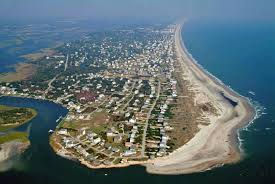
Just west of Fort Macon is Atlantic Beach, the oldest resort town on Bogue Banks. It was first visualized as a seaside resort in the 1870s by Mr. Appleton Oaksmith, a colorful Carteret local who lived across the sound on the mainland in nearby Morehead City. Mr. Oaksmith acquired all of what would become AB and a portion of what would later become PKS but never constructed his resort community after he lost his ambition when four of his daughters died tragically on July 4, 1879. However, Mr. Oaksmith’s vision of a seaside resort was realized a few years later when John J. Royall, a New Englander who owned several islands in nearby Onslow County, purchased the island and constructed the first bathing pavilion on Bogue Banks in 1887 very near the location of the present day Club Colony neighborhood. Mainlanders availed themselves of ferry service to enjoy a day at the beach and AB quickly became a center of dancing and band music, prompting developers to construct the original toll bridge in 1928. Easier access to AB brought more business to an area of AB that became known as the “Circle.” The economic boom of the post-World War II era helped AB develop to its modern level of today and it was during this postwar era that N.C. Highway 58 was extended to the western end of Bogue Banks.
To learn more about living in Emerald Isle, NC, visit my website, www.EmeraldIsleHomesforSaleNC.com and sign up for my blog. Explore the video tab for my weekly uploads to my YouTube channel. Text your email address to 919-308-2292 and be subscribed to my newsletter. In these ways you can still practice social distancing and learn about real estate! Stay well and Stay safe!


Comments